And Thou Art Hotspur the Rebel Lord Who Comes to Take My Throne
How The King Rewrites Shakespeare'due south Virtually Famous Dialogue
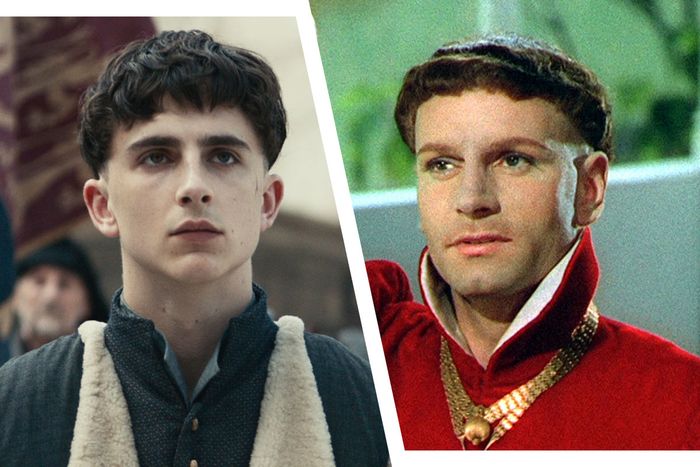
Timothée Chalamet in The Male monarch and Laurence Olivier in Henry V. Photo: Left: Netflix/Right: ITV/Shutterstock
Frustrated writers in search of more confidence would do well to study the example of Joel Edgerton and David Michôd. For their Henry V moving picture The Male monarch, currently streaming on Netflix, the pair borrowed most of the plot, characters, and large moments from Shakespeare's trio of plays almost the monarch, just chose to jettison the Bard's famous verse in favor of dialogue of their ain creation. Edgerton and Michôd aren't the commencement to rewrite Shakespeare — millennials volition retrieve 10 Things I Hate Near You kicked off a wave of adaptations that brought Shakespearean plots to American high schools, efforts that were generally more successful with comedies (She's the Man) than tragedies (O). In that location the change in scenery freed filmmakers from the burden of direct adaptation; in keeping so much the same, the people behind The King have made each deviation feel even more than glaring. Also the linguistic communication, they've likewise changed the fates of a few supporting players, and given the story new themes. Timothée Chalamet's Hal is at present a noble pacifist who disdains state of war and imperialism, which is kind of like turning Romeo into an incel.
Instead of iambic pentameter, characters in The King speak in what we might call Game of Thrones English, a alloy of curt staccato sentences, stentorian pronouncements, a few quondam-timey phrasings, and frequent cursing. How does information technology compare to the original? We've taken excerpts from a few scenes that straight line up with Shakespeare'due south own, to see. (All quotations from the plays courtesy the Open Source Shakespeare projection.)
Both The King and Henry IV, Part 1 begin with a showdown betwixt our hero's imperial father and the future outlaw Harry "Hotspur" Percy. Afterward putting down an army of Scottish rebels, Hotspur has taken prisoners, and won't transfer them to the crown unless Henry 4 ransoms his relative, Mortimer, from the Welsh insubordinate Owen Glendower. The older Henry believes Mortimer is secretly in league with the Welsh, and demands young Hotspur give him the prisoners at once. Here'south how information technology goes downward in Act I, Scene 3 (condensed slightly for length):
HENRY IV
Why, yet he doth deny his prisoners,
But with proviso and exception,
That we at our ain accuse shall ransom straight
His brother-in-constabulary, the foolish Mortimer
[…]
Shall our coffers, then,
Exist emptied to redeem a traitor home?
Shall we but treason? and indent with fears,
When they have lost and forfeited themselves?
No, on the barren mountains let him starve;
For I shall never hold that human being my friend
Whose tongue shall ask me for i penny cost
To ransom domicile revolted Mortimer.
HOTSPUR
Revolted Mortimer!
He never did fall off, my sovereign liege,
Just past the hazard of war; to prove that true
Needs no more simply one tongue for all those wounds,
Those mouthed wounds, which valiantly he took
When on the gentle Severn'south sedgy banking concern,
In single opposition, hand to manus,
He did confound the best part of an hour
In changing hardiment with great Glendower…
HENRY Iv
Thou dost belie him, Percy, thou dost belie him;
He never did encounter with Glendower:
I tell thee,
He durst also have met the devil lonely
As Owen Glendower for an enemy.
Art thou not aback? But, sirrah, henceforth
Let me not hear you speak of Mortimer:
Send me your prisoners with the speediest ways,
Or y'all shall hear in such a kind from me
As will displease you…
In The King, this exchange is broken up into a more traditional conversation between a bunch of characters, but here are the key portions (over again, condensed slightly):
HENRY Iv
I turn down to pay Mortimer'due south ransom considering I turn down to believe him a prisoner. I rather believe Mortimer a traitor. He has joined the Welsh rebels. He has betrayed England, and is at present an enemy of mine, and therefore of yours. You agree with my précis, immature Hotspur?
HOTSPUR
No, your grace. I believe yours to be the ramblings of a crazy onetime demon. Yours are the ramblings of an sometime man so saturated with malice and mistrust that he no longer knows up from down, tin can no longer see beyond the walls of his ain monstrous schloss. My family have served you. We aided you in your ascension and nonetheless we fight for you. Cousin Mortimer has fought for you. And yet now, whilst you slobber over that chicken's fly, he shivers in a western prison house pending mutilation at the hands of Welsh witches…
HENRY IV
Chickens tin't wing. Only I've seen one eke plenty wing-flap to clear a fence. Then information technology's gratis. Merely and then then besides are the foxes. Yous are right, young Percy, I owe you much. I owe your family still more. Merely if the Scottish traitors y'all've taken prisoner are not brought to me as speedily equally they might travel, I will hang yous past your fucking neck. Has this been heard, young Percy?
Hotspur, what a character! His death forms the climax of Henry IV, Part I, just in The King information technology comes simply a few scenes in. In both cases, he perishes at the hands of the futurity Henry V, whose dose of battlefield glory signifies his evolution from drunken young wastrel to capable ruler. In Shakespeare, the fight scene takes place in Act V, Scene 4, as the ii men detect each other on the battleground at Shrewsbury and become into a bit of a contend over their shared commencement name:
HOTSPUR
If I error not, thou art Harry Monmouth.
HENRY V
Thou speak'st every bit if I would deny my proper noun.
HOTSPUR
My name is Harry Percy.
HENRY V
Why, then I see
A very valiant rebel of the name.
I am the Prince of Wales; and think not, Percy,
To share with me in celebrity any more:
Two stars keep non their motion in 1 sphere;
Nor can one England brook a double reign,
Of Harry Percy and the Prince of Wales.
HOTSPUR
Nor shall it, Harry; for the hour is come
To stop the one of u.s.; and would to God
Thy proper noun in arms were at present as dandy as mine!
[…]
[They fight.]
In The King, a boxing is about to begin, but Prince Henry proposes a duel instead, as a way to relieve the lives of the other men in both armies. What a guy!
HOTSPUR
Why is the fiddling dog barking? Where be the big dog?
[Enter Henry Five]
HENRY V
It will be washed.
HOTSPUR
And here I am with the whoring fool.
HENRY V
This fight demand non be had, Percy. My begetter will soon exist dead. Your grievances volition die with him.
HOTSPUR
Don't exist agape of our small-scale contest, immature Hal. I promise to finish it quickly. Come on. Your begetter is plague to England. Come up for me, big domestic dog!
[They fight.]
Henry Four spends most of Henry Four, Part ii slowly dying and being visited by the ghost of Richard II, the guy he deposed. Despite killing Hotspur and proving himself a real human, Prince Henry's relationship with the king hasn't gotten much better. But when he hears his father is close to expiry, he decides to pay the homo 1 terminal visit. In Act 4, Scene 3, he sees the dying king and monologues about embracing his new destiny:
HENRY V
Why doth the crown lie there upon his pillow,
Being so troublesome a frequenter?
O shine'd perturbation! golden care!
That proceed'st the ports of slumber open wide
To many a watchful night! Sleep with information technology at present!
Yet not and then sound and half so deeply sweetness
As he whose brow with homely biggen bound
Snores out the watch of night. O majesty!
When 1000 dost compression thy bearer, thou dost sit down
Like a rich armour worn in rut of day
That scald'st with rubber. By his gates of breath
At that place lies a downy feather which stirs non.
Did he suspire, that low-cal and weightless downwardly
Perforce must motility. My gracious lord! my male parent!
This sleep is sound indeed; this is a sleep
That from this gilded rigol hath divorc'd
Then many English kings. Thy due from me
Is tears and heavy sorrows of the blood
Which nature, love, and filial tenderness,
Shall, O dear father, pay thee plenteously.
My due from thee is this imperial crown,
Which, as firsthand from thy identify and claret,
Derives itself to me. [Putting on the crown.]
In the play, Henry IV somewhen awakes, and father and son share a concluding reconciliation. In The King, that moment is much shorter, and slightly different:
[Enter Henry V]
HENRY 5
You experience this cold? Wrench.
[He tears the sheets from his male parent'due south bed.]
HENRY IV
Hal. Hal. You must be king. I know not what I accept done.
With the expiry of his father, Henry is now king of England, and he takes a moment to address his father'southward councilors. Here's the flowery speech he gives them in Human activity V, Scene two of Henry 4 Part 2:
HENRY V
This new and gorgeous garment, majesty,
Sits not so easy on me as you recollect.
Brothers, y'all mix your sadness with some fear.
This is the English language, not the Turkish court;
Not Amurath an Amurath succeeds,
But Harry Harry. Notwithstanding be sad, good brothers,
For, by my religion, it very well becomes you.
Sorrow so royally in you appears
That I will securely put the fashion on,
And vesture it in my heart. Why, then, be sad;
But entertain no more than of it, expert brothers,
Than a joint brunt laid upon us all.
For me, past sky, I bid yous exist assur'd,
I'll be your male parent and your brother as well;
Let me but deport your dear, I'll behave your cares.
Even so weep that Harry's dead, and so will I;
But Harry lives that shall convert those tears
By number into hours of happiness.
When y'all're plumbing equipment three Shakespeare plays into 1 two-hr movie, y'all've gotta make cuts somewhere, and then The King speeds through Henry IV, Part 2. Its version of the above monologue comes roughly 30 seconds after Henry has stormed into the king'southward bedchamber.
HENRY Five
You know not what volition become of you. So, I offering you this. The most blessed reprieve. The most dreadful misery. Y'all shall suffer the indignity of serving me, the wayward son you so revile. But know at present you will be watched over by an birthday different male monarch.
Both versions of the story include a scene where the Dauphin of France taunts Henry by sending him a souvenir of tennis balls. In Henry V, the young king immediately takes information technology equally a claiming, and vows to cross the Channel and press his claim to the French throne. Here's his speech from Act I, Scene two (over again, slightly condensed):
HENRY V
We are glad the Dauphin is so pleasant with us;
His present and your pains we thank yous for:
When we have march'd our rackets to these balls,
We will, in French republic, by God'southward grace, play a ready
Shall strike his father'southward crown into the hazard.
Tell him he hath made a friction match with such a wrangler
That all the courts of France will be disturb'd
With chaces. And we empathise him well
[…]
Only tell the Dauphin I volition keep my state,
Be like a rex and prove my sail of greatness
When I do rouse me in my throne of France:
For that I have laid by my majesty
And plodded similar a man for working-days,
But I volition rising at that place with so full a glory
That I will dazzle all the optics of French republic,
Yea, strike the Dauphin bullheaded to look on us.
And tell the pleasant prince this mock of his
Hath turn'd his assurance to gun-stones; and his soul
Shall stand up sore charged for the wasteful vengeance
[…]
So go you hence in peace; and tell the Dauphin
His jest will savour merely of shallow wit,
When thousands weep more than than did laugh at it.
Convey them with safety conduct. Fare you well.
By contrast, the aware Henry of The King does not care about claiming the French throne, then does non consider a gift of sporting equipment acceptable pretext for invading France.
HENRY V
A ball. In that location is no accompanying message from the Dauphin?
COURTIER
No, my liege.
HENRY 5
I shall keep this gift. This one is sent just for me. For the male child I once was.
[Later]
Principal JUSTICE
The ball is an insult to you and to your kingdom. You must respond.
HENRY Five
Call up where as prince I whiled and how I spent my days?
Chief JUSTICE
You spent them in considered privation.
HENRY Five
Drinking, clowning. So is there not some truth in this jest? If the Dauphin wants from me a paroxysm, why give it to him?
Primary JUSTICE
It would not be a testify of foul temper for you to respond forcefully to an insult such as that. Information technology would be a show of strength.
HENRY Five
I appreciate your umbrage, William. But my strength does non lie in my flapping up and down at the slightest affront like some unholy mechanical bird.
Merely because this is the story of Henry V, yous can't but write out the role where he invades France. Both stories also take to shoehorn in the Southampton Plot, where a few of Henry'south advisers plotted to put his distant relative on the throne, got found out, and were executed soon before the king set up canvass. In the play, Henry tricks the advisers into pressing for a harsh sentence confronting those who accept spoken out against the male monarch, then presents them with letters proving their guilt. Having but argued against mercy, the men can't need it for themselves:
HENRY V
And at present to our French causes:
Who are the late commissioners?
EARL OF CAMBRIDGE
I one, my lord:
Your highness bade me ask for it to-twenty-four hour period.
LORD SCROOP
So did y'all me, my liege.
SIR THOMAS Grayness
And I, my royal sovereign.
HENRY V
Then, Richard Earl of Cambridge, there is yours;
There yours, Lord Scroop of Masham; and, sir knight,
Grey of Northumberland, this aforementioned is yours:
Read them; and know, I know your worthiness.
My Lord of Westmoreland, and uncle Exeter,
We will aboard to night. Why, how at present, gentlemen!
What meet you in those papers that you lot lose
So much complexion? Look ye, how they change!
Their cheeks are paper. Why, what read y'all there
That hath and so cowarded and chased your blood
Out of appearance?
EARL OF CAMBRIDGE
I exercise confess my fault;
And do submit me to your highness' mercy.
SIR THOMAS Grey
[with Scroop] To which nosotros all appeal.
HENRY V
The mercy that was quick in us but tardily,
By your own counsel is suppress'd and impale'd:
You must not dare, for shame, to talk of mercy;
For your own reasons plough into your bosoms,
As dogs upon their masters, worrying yous.
Henry continues with another longer voice communication, but nobody'southward got time for that in a Netflix flick. Edgerton and Michôd dispense with the letter shenanigans and go directly to the point:
HENRY 5
As of today, we are at war with France. Twice I have given her the do good of my dubiousness. This third affront will not exist left unchecked. And so, in society to flush these French rats from their nests, I will accept it communicated to them that we are now at war. My lord Grey, Cambridge, I would enquire you to deliver this message to France, given your … familiarity with its recipient. But I believe in the morning you'll be otherwise engaged.
EARL OF CAMBRIDGE
Pray how, my liege?
HENRY V
Tomorrow yous will accept your heads cut off.
Finally, the oratory y'all've been waiting for ever since yous clicked into this mail service. With The Male monarch skipping the boxing at Harfleur that gives us the "Once more than unto the alienation" oral communication, Henry's famous pre-battle monologue at Agincourt is the filmmakers' big gamble to put their own spin on Shakespeare'due south almost stirring language. If yous've forgotten information technology, here information technology is (in total), from Act Four, Scene three:
EARL OF WESTMORELAND
O that we now had hither
Simply one ten k of those men in England
That do no work to-24-hour interval!
HENRY 5
What'south he that wishes so?
My cousin Westmoreland? No, my off-white cousin:
If nosotros are marker'd to dice, we are enow
To do our country loss; and if to live,
The fewer men, the greater share of honour.
God's will! I pray thee, wish not one homo more.
Past Jove, I am not covetous for gold,
Nor care I who doth feed upon my cost;
It yearns me not if men my garments wear;
Such outward things dwell not in my desires:
But if information technology be a sin to covet honour,
I am the most offending soul alive.
No, faith, my coz, wish not a man from England:
God's peace! I would not lose and so great an award
Every bit one human being more than, methinks, would share from me
For the all-time promise I have. O, do not wish one more!
Rather proclaim it, Westmoreland, through my host,
That he which hath no stomach to this fight,
Let him depart; his passport shall be fabricated
And crowns for convoy put into his bag:
We would not die in that man'south company
That fears his fellowship to die with us.
This day is called the feast of Crispian:
He that outlives this mean solar day, and comes condom home,
Volition stand a tip-toe when the 24-hour interval is named,
And rouse him at the proper name of Crispian.
He that shall live this day, and come across old age,
Volition yearly on the vigil feast his neighbours,
And say 'To-morrow is Saint Crispian:'
So will he strip his sleeve and show his scars.
And say 'These wounds I had on Crispin'southward twenty-four hour period.'
Quondam men forget: yet all shall be forgot,
But he'll call up with advantages
What feats he did that twenty-four hour period: so shall our names.
Familiar in his oral fissure as household words
Harry the king, Bedford and Exeter,
Warwick and Talbot, Salisbury and Gloucester,
Be in their flowing cups freshly recollect'd.
This story shall the practiced human being teach his son;
And Crispin Crispian shall ne'er get by,
From this twenty-four hours to the ending of the world,
But we in information technology shall be remember'd;
We few, nosotros happy few, nosotros ring of brothers;
For he to-day that sheds his blood with me
Shall be my blood brother; be he ne'er so vile,
This day shall gentle his condition:
And gentlemen in England now a-bed
Shall think themselves accursed they were non here,
And hold their manhoods inexpensive whiles any speaks
That fought with us upon Saint Crispin's twenty-four hours.
There was absolutely no way The King was going to exist able to top this. But at least they gave information technology a try! Here's what Michôd comes up with:
HENRY Five
You expect of me a spoken language? I have only 1 to give. It is the same i I'd requite were we not standing on the brim of a battlefield. It is the aforementioned one I'd give were we to meet in the street by chance. I accept only ever hoped for one thing: to run into this kingdom united under this English crown. All men are born to die. We know it. We carry it with the states ever. If your solar day be today, so be information technology. Mine will exist tomorrow. Or mine today and yours tomorrow. Information technology matters not. What matters is that you know in your hearts that today you are that kingdom united. You lot are England, each and every one of you. England is y'all. And it is the infinite between you. Fight not for yourselves. Fight for that space. Fill that space. Make it tissue. Go far mass. Brand information technology impenetrable. Make information technology yours! Make it England! Make it England! Great men to information technology, captains, lords. Great men to it!
Out of respect to Shakespeare's genius pacing, The King decides to join the Bard in post-obit upward the super-exciting battle of Agincourt with a very talky scene of Henry flirting with his future French married woman, Katharine. Except … she doesn't speak English! What is a horny male monarch to do, except endeavor to woo her anyway, with the help of Alice, a lady-in-waiting. Here's a portion of their exchange from Act V, Scene two:
HENRY V
Fair Katharine, and about fair,
Volition you lot vouchsafe to teach a soldier terms
Such as will enter at a lady'south ear
And plead his honey-suit to her gentle eye?
KATHARINE
Your majesty shall mock at me; I cannot speak your England.
HENRY V
O off-white Katharine, if y'all will love me soundly with your French middle, I will be glad to hear you confess it brokenly with your English language tongue. Exercise you like me, Kate?
KATHARINE
Pardonnez-moi, I cannot tell vat is 'like me.'
HENRY Five
An affections is like y'all, Kate, and you are similar an angel.
KATHARINE
Que dit-il? que je suis semblable a les anges? [What is he proverb? That I resemble an angel?]
ALICE
Oui, vraiment, sauf votre grace, ainsi dit-il. [Yep, that's what he'southward proverb.]
HENRY V
I said and so, dear Katharine; and I must non blush to assert information technology.
KATHARINE
O bon Dieu! les langues des hommes sont pleines de tromperies. [Oh God! The language of men is full of charade.]
HENRY V
What says she, fair one? that the tongues of men are full of deceits?
ALICE
Oui, dat de tongues of de mans is be full of deceits: dat is de princess.
HENRY Five
The princess is the meliorate Englishwoman. I' organized religion, Kate, my wooing is fit for thy agreement: I am glad chiliad canst speak no better English; for, if k couldst, grand wouldst find me such a plain male monarch that 1000 wouldst call up I had sold my farm to buy my crown. I know no ways to mince it in love, only directly to say 'I beloved you:' so if you urge me farther than to say 'practise y'all in faith?' I wear out my accommodate. Give me your respond; i' organized religion, exercise: and so clap hands and a bargain: how say you, lady?
KATHARINE
Sauf votre honneur, me understand vell.
The scene in the play goes on for quite some time afterward that, but I'll spare you more blocks of text. The Rex, funnily enough, treats Henry and Katharine's little linguistic communication games with a lot more than reverence than information technology does the residue of Henry V, but information technology also throws in a twist! Katharine is not just a very progressive 15th-century noblewoman who believes "all monarchy is illegitimate," she also helps Henry wake up to the real enemy:
KATHARINE
[In French] Please sit, your majesty.
HENRY V
[In French] Yous are cute.
KATHARINE
Merci.
HENRY V
[In French] I will no longer speak French. Nosotros must speak English.
KATHARINE
[In French] I cannot speak English.
HENRY V
[In French] You will larn.
KATHARINE
[In French] I wonder then, how our union might proceed in the meantime.
HENRY V
There is much I wonder about a dandy many things.
KATHARINE
Indeed at that place must be for you to contemplate marriage to a adult female about whom you know so fiddling. I will not submit to you. You must earn my respect.
HENRY V
I understand that.
KATHARINE
Do you?
HENRY V
I do.
KATHARINE
Practice you lot experience a sense of achievement?
HENRY 5
In what regard?
KATHARINE
In any regard.
HENRY V
I have achieved that which my begetter never could. I take united this kingdom in common cause.
KATHARINE
You have accomplished momentary respite. A unity forged under false pretense will never exist a unity that prevails.
HENRY V
How, pray, accept my endeavors been forged falsely?
Equally it turns out, in this telling, Henry is a dainty, peaceful chap who really didn't want to commit war crimes — he was simply tricked into invading France by his evil counselors! While this twist bears heavy similarities to actual medieval propaganda, I doubtable the filmmakers' intent had more to do with drama than history. As the movie'southward Falstaff, having evaded the fate Shakespeare gave him, says on the eve of Agincourt: "Either I die here, or I die over a canteen in Eastcheap. I think this makes for a much better story." I'll get out it up to you to decide whether that's truthful or not.
jenningscomee1996.blogspot.com
Source: https://www.vulture.com/2019/11/how-netflixs-the-king-re-writes-shakespeares-dialogue.html
0 Response to "And Thou Art Hotspur the Rebel Lord Who Comes to Take My Throne"
Post a Comment